
It depends on whether your RFI is really a communication the contract requires an answer to. If it is, an unanswered RFI can become a compensation event under 60.1(6), but only where the missed period actually affects cost or time; if it isn't, you need to turn it into something that is.
"RFI" isn't an NEC term. The contract doesn't care about the form's title, only what it asks. Clause 13.3 requires a reply within the period for reply in the Contract Data when the contract requires a reply, and that's the same in NEC3 and NEC4. See also the wider NEC questions section.
Next steps, in order
- Work out the date the answer was due. Date received plus the period for reply. Check whether anyone agreed an extension before that date under 13.5.
- Give an early warning now if the delay could matter. Say which operation is waiting and the last date that avoids an effect.
- Re-send it in contract terms. Use the table below to pick the right route, and send it to the Project Manager.
- Notify 60.1(6) if there's a real effect. A missed reply isn't one of the events that escapes the time bar, so the eight weeks in clause 61.3 runs from when you knew the reply had been missed.
- Do what you can meanwhile. The assessment assumes a competent, prompt reaction. Re-sequence where that's sensible, and record why you did or didn't.
What your question really is
| The RFI is really | Contract route | Why it helps |
|---|---|---|
| Pointing out that documents conflict | Notification under 17.1 | The Project Manager has to say how it's resolved, by an instruction that can be an event |
| Asking for something the Client has to provide, such as a missing drawing | Check the date on the Accepted Programme: 60.1(3) | The test is the programme date, not the period for reply |
| Asking for information from a separate designer or Others | Possibly 60.1(5), if the times shown were missed | Your programme should show the date you need information from Others |
| Seeking acceptance of a proposal or a design | Submission for acceptance: 13.4 | A reply is plainly required |
| A general query about how to build something | Probably no contract route | It's your job to work out the method. Don't expect 60.1(6) to help |
Sample chaser
Is the effect worth notifying?
The contract says 60.1(6) is triggered by the missed period itself. But under clause 61.4 an event with no effect on Defined Cost, Completion or a Key Date doesn't change anything. So a reply that comes three days late, on an activity with four weeks of float, is an event with no assessment attached. A reply that holds up a critical pour is another matter. Our page on late replies as an event works through the valuation.
In practice, an RFI log with hundreds of open items is its own problem. Rank them: which ones hold up work, and by when? Send a short list of the ones that matter, with the dates they matter by, to the Project Manager. A long unsorted log gives the other side an easy answer: nobody could tell what was urgent.
What the Project Manager may answer
- "The contract doesn't require a reply to an RFI." Sometimes correct, which is why you use the routes above. Check whether your Scope sets up an RFI procedure, because that can change things.
- "The answer was already in the documents." If so, 60.1(6) won't help you much, because the delay was yours. Look before you claim.
- "You asked too late for us to answer before you needed it." Give the period for reply in your planning. Sending a question on day one of a two-week period, for work starting next Tuesday, doesn't make the Project Manager late.
To keep the dates under control, see tracking periods for reply.
Related guides
- NEC Questions Answered: Real Situations on Site
- The Project Manager Replied Late: Is It Automatically a Compensation Event?
- Can We Carry On Without a Written Instruction?
- The Client Told Us on Site to Change Something: Is That Valid?
- Our Own Designer Is Late With Drawings: Who Pays?
- Revised Drawings Arrive After IFC: Is That a Change to the Scope?
How this looks in Contract Status
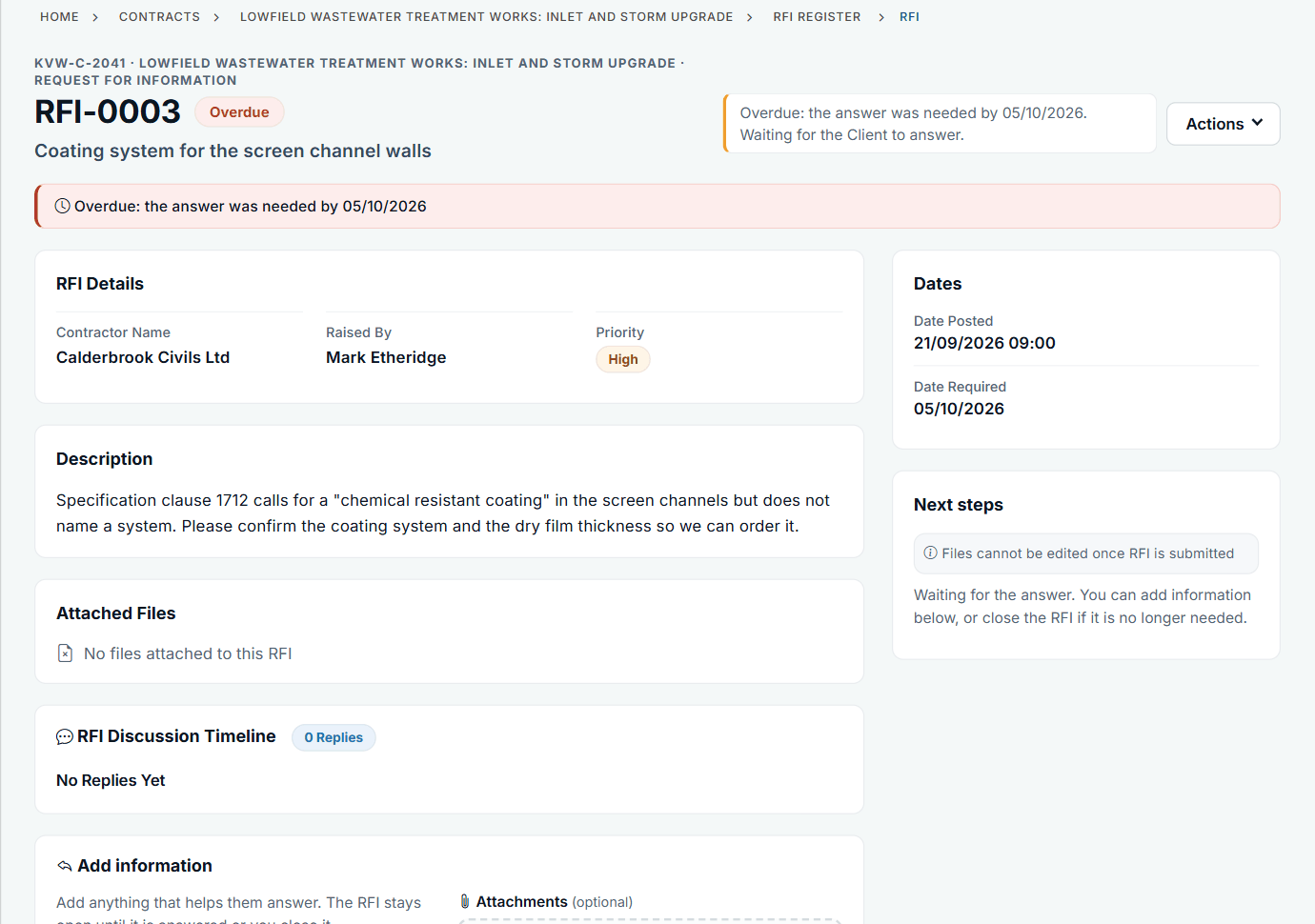
An overdue RFI from the Contractor side, waiting for the Client. See the worked example.
See how this works in practice
Click through Contract Status with sample contracts: raise the notice, reply to it, and watch both sides of one record.
Take the guided tour Book a demo
Use the NEC deadline calculator, use the free NEC tools or download free NEC templates.
This guide is general information in our own words, not legal advice. Your contract and its Contract Data always govern. NEC, NEC3 and NEC4 are trade marks of Thomas Telford Ltd; Contract Status is not affiliated with or endorsed by NEC.