
Yes on the wording, but often with no money or time attached. A late reply is a compensation event under 60.1(6) if the contract required a reply from the Project Manager or Supervisor to your communication and the period was missed; it only changes the Prices or dates if the lateness had an effect.
So being late isn't the deciding fact. The questions are which period applied, whether it was properly extended, and what the lateness did to Defined Cost, Completion or a Key Date. The wording is effectively the same in NEC3 and NEC4 ECC. See the rest of our NEC questions.
What to do when a reply comes late
- Record both dates: when the reply fell due, and when it came (or that it hasn't).
- Check for an extension. Clause 13.5 allows one only if it's agreed before the reply is due. One agreed in time means no late reply.
- Measure the effect. Did anything wait? Did a price or slot get lost? Did planned Completion move?
- If there's an effect, notify within eight weeks. Clause 61.3 applies, because this event doesn't come from an instruction or decision. Count from when you knew the reply had been missed. The NEC4 subcontract has seven weeks.
- If there's no effect, note it and move on. Keep it in the log. A pattern can be useful in a discussion with the Client later.
Not every late reply has the same remedy
| Reply missed | Period in NEC4 ECC | Stronger route? |
|---|---|---|
| Your compensation event notification | 1 week (61.4) | Yes: notify the failure, then treated as a compensation event after 2 more weeks |
| Your quotation | 2 weeks (62.3) | Yes: notify the failure, then treated as accepted after 2 more weeks |
| Project Manager's own assessment | The time allowed for a quotation (64.3) | Yes: notify the failure, and your quotation is treated as accepted after 2 more weeks (64.4) |
| Programme for acceptance | 2 weeks (31.3) | In NEC4 only: see programme deemed acceptance |
| Other submission for acceptance, or a communication needing a reply | Period for reply (13.3, 13.4) | No. 60.1(6) is the main remedy |
| A communication where the contract requires no reply | None | No. 60.1(6) doesn't apply |
Where a stronger route exists, use it first. It doesn't need you to prove any effect. Under the NEC4 subcontract the periods are longer in places (for example, 2 weeks to reply to a notification, and a further 3 weeks after notice).
A fictional example
The period for reply is two weeks. A Contractor submits a proposed temporary works design for acceptance on 1 April; the reply is due on 15 April. It arrives on 22 April, a week late, and accepts the design.
| Scenario | Result |
|---|---|
| The works weren't planned to start until 6 May | 60.1(6) was triggered, but with no effect. Under 61.4 the Prices and dates aren't changed |
| The works were due to start on 16 April, on the critical path | A week's delay to planned Completion, subject to any float, plus time-related Defined Cost and Fee |
| Works were due on 16 April, but the Contractor's scaffold wasn't ready until 24 April anyway | The reply didn't cause the loss. Little or nothing to assess |
What the Project Manager will probably say
Expect "it made no difference", backed by your own progress records. Also expect a check on whether your submission was complete: the contract lets the Project Manager withhold acceptance if it needs more information, though it still has to reply within the period to say so. If your first submission lacked what it needed, you may get a timely rejection, not a late acceptance.
Contract and practice
The contract treats every missed period the same way. In practice, notifying every late reply damages relations and rarely pays. Notify where there's a real effect, and raise the rest with the Project Manager as a pattern. The route in the 60.1(6) guide sets out what evidence to keep. The eight-week limit is the thing to watch: "we'll raise it later" can quietly become a missed time bar.
Related guides
- NEC Questions Answered: Real Situations on Site
- Can We Carry On Without a Written Instruction?
- The Client Told Us on Site to Change Something: Is That Valid?
- The Client Keeps Instructing the Contractor Directly: What Should We Do?
- Revised Drawings Arrive After IFC: Is That a Change to the Scope?
- Our RFI Has Not Been Answered: What Can We Do?
How this looks in Contract Status
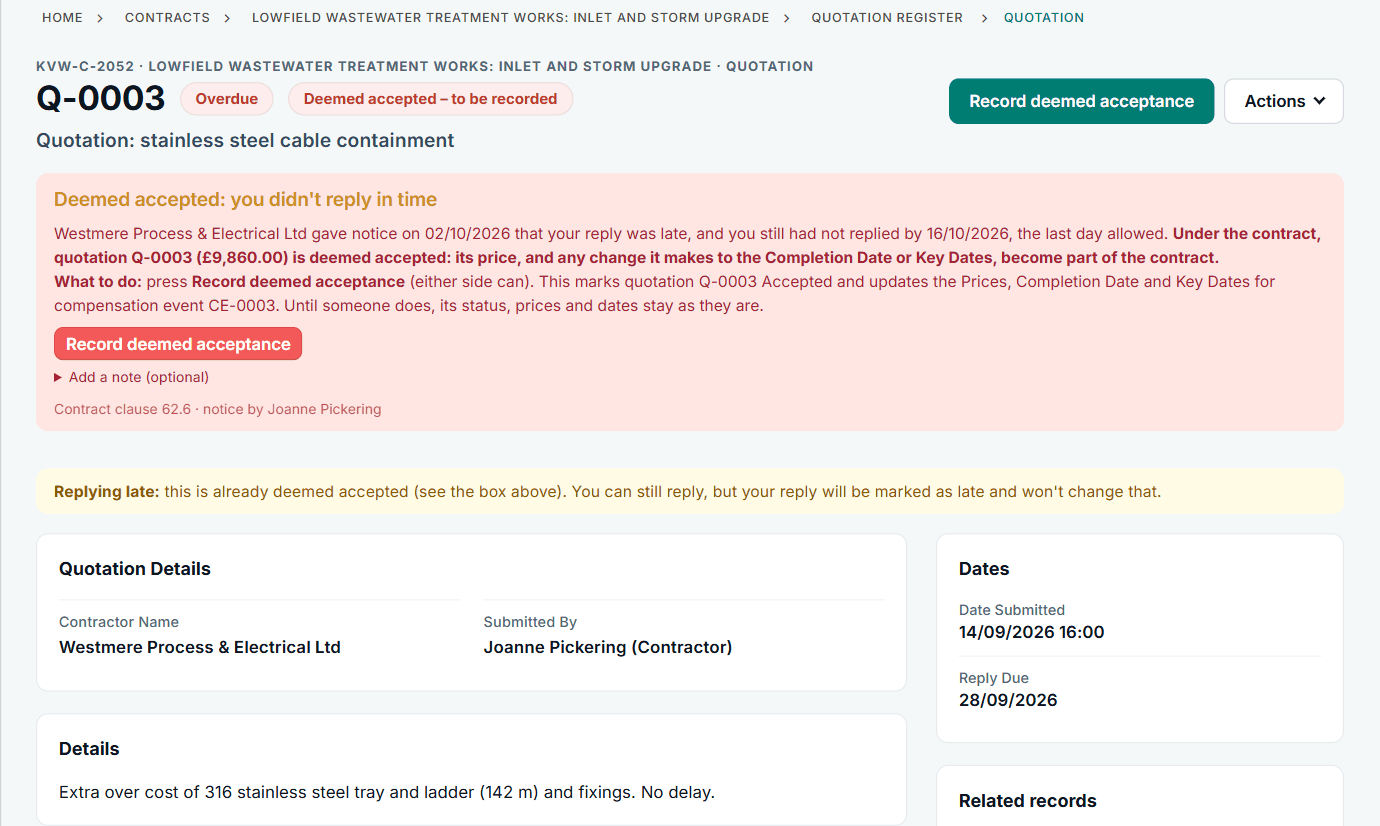
A quotation treated as accepted, as the Client side sees it. See the worked example.
See how this works in practice
Click through Contract Status with sample contracts: raise the notice, reply to it, and watch both sides of one record.
Take the guided tour Book a demo
Use the NEC deadline calculator, use the free NEC tools or download free NEC templates.
This guide is general information in our own words, not legal advice. Your contract and its Contract Data always govern. NEC, NEC3 and NEC4 are trade marks of Thomas Telford Ltd; Contract Status is not affiliated with or endorsed by NEC.