
No. An early warning doesn't admit liability or fault, because clause 15.1 only asks you to flag a matter that could affect cost, time or performance, whoever is responsible. It decides nothing about who pays, so an early warning does not admit liability any more than it proves a claim.
What can hurt you is how it's written. A warning is still a record, and any statement in it can be used as evidence later. So state the facts and leave out the blame. The same rule is at 16.1 in NEC3.
What a warning does and doesn't do
| It does | It doesn't |
|---|---|
| Puts a matter on the Early Warning Register | Decide who bears the cost |
| Lets both sides look for ways to reduce the effect, at a meeting if needed | Change the Prices or dates by itself |
| Protects you from a statement under 61.5 about a warning that could have been given | Count as a compensation event notification: see why |
| Fix a date showing when you knew | Waive any right you have |
That last line in the left column has an edge. A warning shows when you became aware of something, and that can matter for the eight weeks under 61.3. So be accurate.
The real risk is silence
If an experienced contractor could have warned and didn't, the Project Manager can say so under 61.5, and the related event is assessed as if you'd warned. On cost-based Options there's a further exposure through Disallowed Cost. See the cost of not warning. Nothing in the contract penalises a warning for being made.
If you're worried about a warning today
- Send it now. The duty is to warn as soon as you're aware, and a delay while you settle your position defeats the purpose.
- State the matter, not the cause, unless the cause is plain and neutral.
- Say which effects are possible, using "could".
- Suggest a next step, such as options or a meeting.
- Check against the facts. If your own team made an error, don't deny it or hide it. Simply don't turn the warning into a statement about fault.
- Separately, work out the commercial position and whether anything needs notifying under 61.3.
Wording that helps, and wording that doesn't
| Avoid | Better |
|---|---|
| "Due to our error, the rebar is wrong and we'll be late." | "Rebar delivered to Bay 3 doesn't match the current drawing. This could delay Key Date 2. We're checking the cause and options." |
| "The Client's consultant has failed to provide the drawing, and we'll claim." | "Drawing X isn't yet with us. The Accepted Programme needs it by [date]. This could delay Completion." |
| "We accept responsibility for any delay." | Leave this out. A warning doesn't need it |
| "This is without prejudice." | Leave this out as well. It's a contract communication, not a settlement offer |
The early warning template sets out a suitable format.
A fictional example
A Contractor's concrete supplier has a mechanical breakdown, and the deck pour may slip by a week. The site team hesitates, because the delay looks like it's their risk, and a warning might read as an admission. They warn anyway. At the meeting, the Project Manager mentions that the Client's fit-out contractor could use the deck later than planned. A resequence takes most of the delay out. The warning cost nothing, and the risk was the Contractor's whether it warned or not.
What the other side might say
A Project Manager may later say, "You warned about this, so you knew and you accepted it." The contract doesn't support the second half of that. Reply that the warning records a possible effect, and nothing more. The first half can be true, which is where the date of awareness comes in. Conversely, when the Project Manager warns of something the Client might have caused, a Contractor shouldn't treat that as a concession that a compensation event exists. It still needs to be notified and tested.
Contract and practice
The contract says the warning is a duty for both the Contractor and the Project Manager. In practice, a warning culture only works if people aren't punished for giving them. If you run a team, make it clear that a warning raised early is good work, whatever the cause turns out to be. See what an early warning is for the basics, and if a legal claim is already running, take advice on your communications. More answers are in the NEC questions hub.
Related guides
- NEC Questions Answered: Real Situations on Site
- Can We Give Too Many Early Warnings?
- Does an Early Warning Count as Notifying a Compensation Event?
- We Gave an Early Warning and the PM Ignored It
- The Project Manager Works for the Client: Are They Impartial?
- The Relationship Has Broken Down: What Does Clause 10 Actually Require?
How this looks in Contract Status
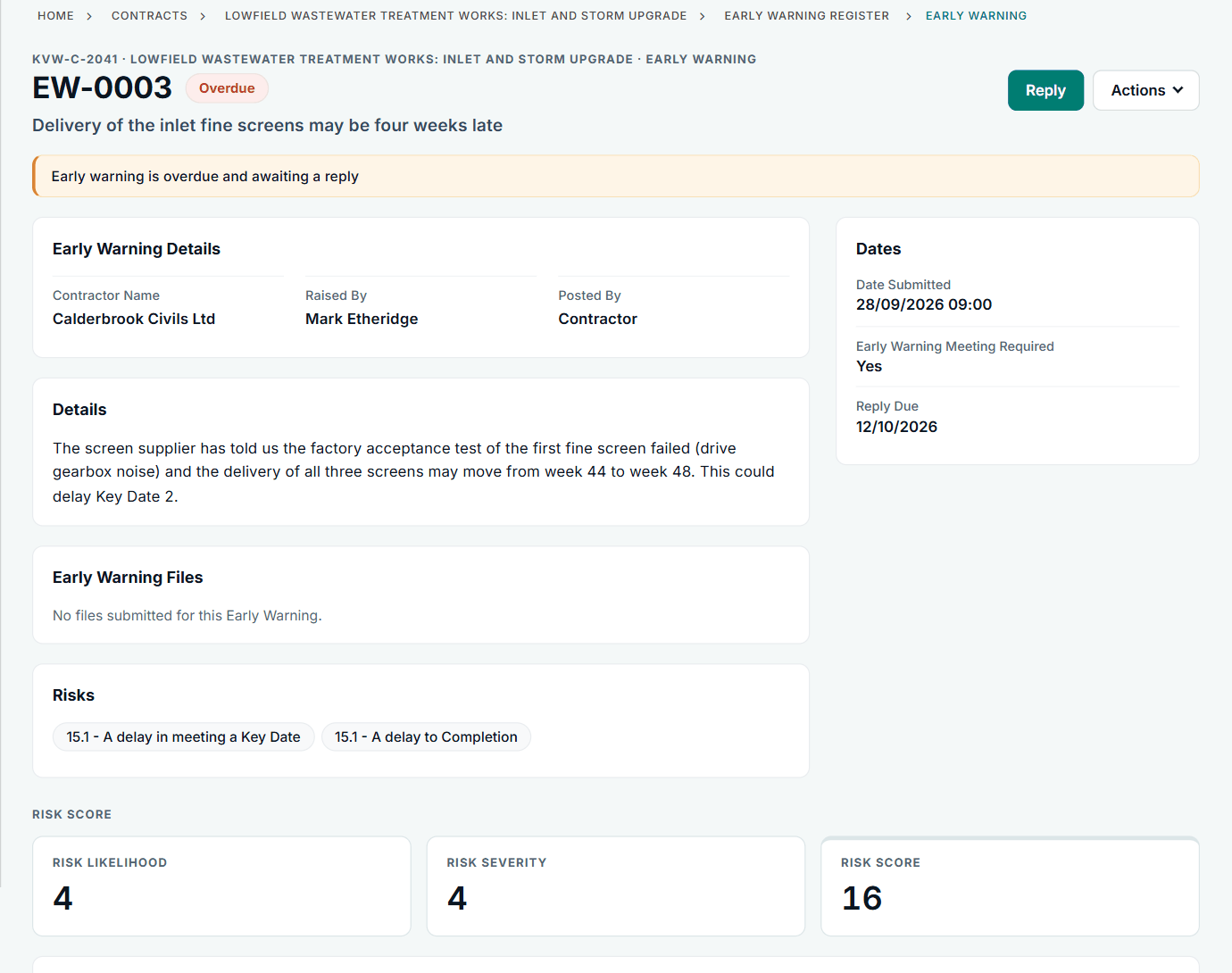
An early warning in Contract Status, with its risks, reply date and score. See the worked example.
See how this works in practice
Click through Contract Status with sample contracts: raise the notice, reply to it, and watch both sides of one record.
Take the guided tour Book a demo
Use the NEC deadline calculator, use the free NEC tools or download free NEC templates.
This guide is general information in our own words, not legal advice. Your contract and its Contract Data always govern. NEC, NEC3 and NEC4 are trade marks of Thomas Telford Ltd; Contract Status is not affiliated with or endorsed by NEC.