
A new Project Manager can change earlier decisions, but it usually costs the Client: when a project manager changed decision that had already been communicated, it's a compensation event under clause 60.1(8). A change of person doesn't reset anything, as the role continues under clause 14.4.
What decides your position is what's being reversed. An implemented compensation event is treated differently from a past acceptance, and a certified payment is different again. The clause numbers are NEC4 ECC, and the event has the same number in NEC3.
What can and can't be reversed
| Earlier decision | Can the new PM change it? | Effect |
|---|---|---|
| Acceptance of a design, programme or method | Yes, in practice | Compensation event, 60.1(8), if there's an effect on cost or time |
| An instruction | Yes, by a new instruction | 60.1(8), and usually 60.1(1) if the Scope changes |
| An implemented compensation event | No, except where the contract allows. Under 66.3, an implemented assessment stays as it is | Refuse to reopen it |
| A payment certificate | Yes, it can be corrected in a later certificate if it was wrong (50.6 in the NEC4 subcontract text; 50.5 in NEC3 ECC) | The new assessment has to be supportable, and it may be disputed |
| A view in a meeting or email that wasn't a decision | Yes | Probably not an event. There was no decision to change |
| A reply to a compensation event notification | Treat as a changed decision if it was clearly communicated | 60.1(8). Look at the facts, and watch any W1 period |
What to do when it happens
- Find the original communication. Note who sent it, the date and the authority. A delegate needs to have been notified under 14.2.
- Follow the new decision if it's an instruction that the contract allows. Clause 27.3 still applies.
- Reply in writing, identifying the earlier decision and saying that it's been changed.
- Check that the Project Manager has notified. The contract says it should do so at the time, under 61.1, and instruct quotations. If not, notify under 61.3.
- Don't sit on it. The contract's eight-week bar doesn't apply to an event that arises from changing an earlier decision, in NEC3 or NEC4. But delay weakens the evidence of cost.
- If you're on W1, diarise four weeks to dispute an action of the Project Manager. Check your own Option: see dispute time limits.
Sample letter
"Your instruction of [date] requires [new requirement]. [Previous Project Manager] communicated on [date] that [earlier decision], and we have worked on that basis since. We consider this a change to a decision previously communicated, and so a compensation event under clause 60.1(8). Please notify it under clause 61.1 and instruct quotations. We've put your instruction into effect from [date]."
A worked example
A fictional hospital car park, with illustrative figures. The first Project Manager accepted the Contractor's drainage design in March, and the pipes were ordered. In June, a replacement Project Manager says the design shouldn't have been accepted and withdraws the acceptance, with no reason from the contract. The Contractor's cost of changing the order and redrawing is £31,000, with a week's delay. It notifies 60.1(8), and adds 60.1(9) as an alternative, because acceptance has in effect been withheld for a reason the contract doesn't give.
Now change one fact. The design actually breached the Scope. The acceptance didn't change the Contractor's responsibility, because of 14.1. The new Project Manager can notify a Defect, and the Contractor's event isn't a clear winner. So read your own design before you write.
What the new PM may say
- "My predecessor got it wrong." That may well be so, but the event doesn't need the earlier decision to have been right.
- "That wasn't a decision." So keep your replies specific. Check how the original was written.
- "You had no reasonable basis to rely on it." The event doesn't list reliance as a test. The effect still needs to be shown.
- "The person lacked authority." Check for any notified delegation. The guide to clause 14 sets this out.
Advice for the new Project Manager
Read the file before changing anything. Take a handover note of open quotations, acceptances and replies, because periods keep running through the change. Where you do change something, say so and notify it. Trying to reopen implemented events tends to cost goodwill and rarely succeeds under 66.3. If you need a fresh start, a short meeting on the open items works better than a series of reversals.
The guide to compensation event 60.1(8) explains the test in more depth, and the NEC questions hub has related situations.
Related guides
- NEC Questions Answered: Real Situations on Site
- The Project Manager Works for the Client: Are They Impartial?
- The Relationship Has Broken Down: What Does Clause 10 Actually Require?
- Does Giving an Early Warning Admit Fault?
- Can We Still Refer a Dispute After the Time Limit?
- Should We Go to Adjudication or Keep Negotiating?
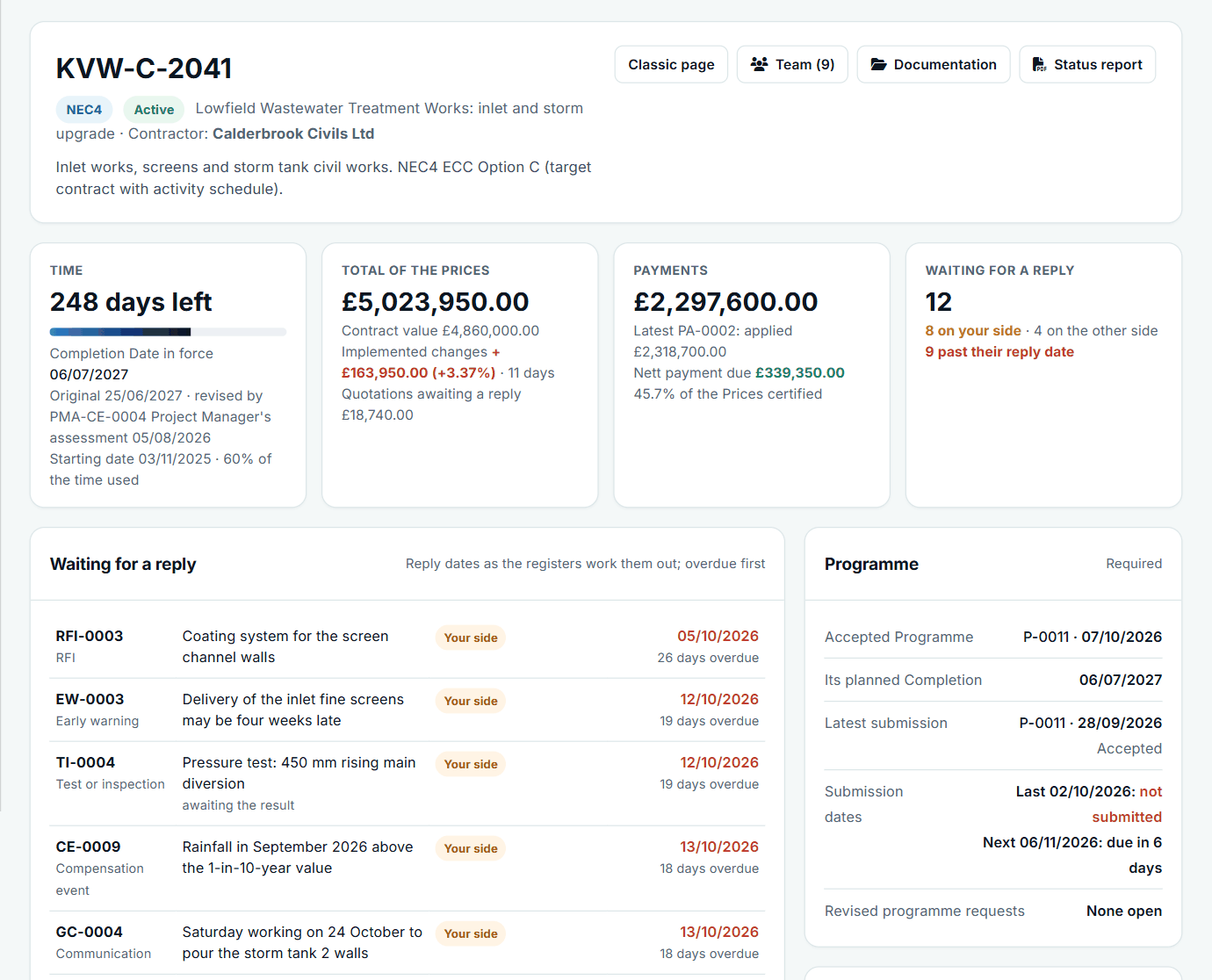
See how this works in practice
Click through Contract Status with sample contracts: raise the notice, reply to it, and watch both sides of one record.
Take the guided tour Book a demo
Use the NEC deadline calculator, use the free NEC tools or download free NEC templates.
This guide is general information in our own words, not legal advice. Your contract and its Contract Data always govern. NEC, NEC3 and NEC4 are trade marks of Thomas Telford Ltd; Contract Status is not affiliated with or endorsed by NEC.