
Not necessarily, but treat it as serious. If you missed the 8 week time bar under NEC clause 61.3, the Prices and dates don't change for that event, unless the event came from a Project Manager's or Supervisor's communication, or your dates turn out to be wrong.
Three things decide it: where the event came from, when you actually became aware, and whether the Project Manager has already replied or stayed silent. These numbers apply to NEC4 ECC. The NEC4 subcontract allows seven weeks, not eight, so read your own form. See also the NEC questions section.
Do this today
- Notify anyway. Send the notification today. A late notice costs nothing, and every extra day weakens any argument. Don't state a date of awareness you can't support.
- Pin down the event's source. If it arises from an instruction, notification, certificate or changed decision by the Project Manager or Supervisor, the bar doesn't apply. See when the PM should have notified.
- Test the awareness date. Search diaries, emails and meeting notes for the first sign that the event had happened. Be honest about what you find.
- Watch the reply clock. The Project Manager has a week to reply. If it says nothing, you can notify that failure, and after two further weeks the event is treated as accepted under 61.4. Silence has its own route.
- Check for amendments. Z clauses can change this period, so read yours before relying on eight weeks.
Lines of argument, strongest first
| Argument | When it works | Weak if |
|---|---|---|
| The bar doesn't apply to this event | The event arose from a Project Manager or Supervisor communication | The event is late access, weather, physical conditions, Others or a missed reply |
| The clock started later | The event hadn't actually happened, under NEC4's wording, when you first heard it might | Your own diary shows it had. Under NEC3, awareness of the event may be enough |
| It's a new event | A second, separate event occurred later, such as a further late drawing | You are simply slicing up one event |
| Someone already had notice | An earlier communication really was a notification of the event | It was only an early warning or a line in the minutes |
| The time bar was waived, or can't be relied on | A legal question that turns on what was said and done | Don't plan on this without advice |
What it costs depends on your Option
| Main Option | Effect if the event is time-barred |
|---|---|
| A and B | You bear the cost in full, and the Completion Date doesn't move |
| C and D | The cost is still paid as Defined Cost unless disallowed, but the target doesn't rise, so it passes through your share. The date doesn't move |
| E | The cost is paid unless disallowed, and it's mainly the time that's lost. Delay damages may then apply if the contract includes Option X7 |
A fictional example
A groundworker hits a buried slab on 2 February. The site team works around it. On 20 April, the QS finds it in a diary. Eight weeks ended on 30 March. The slab isn't in the Site Information, and the case under 60.1(12) would have been a good one. The Contractor notifies that day and says it became aware on 2 February, because the diary says so. The Project Manager replies within a week that it was late.
The Contractor still has a conversation to have. It shows the Client what was found and what removing it cost, and proposes an agreed sum. Any deal changing the Prices outside the contract's mechanisms needs a signed agreement under clause 12.3. Whether that's offered is up to the Client, not something the contract gives you.
What the other side will say
Expect a short reply citing 61.4 and your own dated records. It's the Project Manager's job to apply the contract, so don't assume goodwill alone will fix it. Any dispute has its own time limits, and if a large sum is at stake, take legal advice early, since the bar's force in your facts is a question for a lawyer.
Preventing the next one
The contract clock runs from what your people knew, not from what the QS knew. So get a short daily "anything odd?" question to supervisors, and review the diaries weekly. More in our guide to clause 61.3 and the list of NEC time bars.
Related guides
- NEC Questions Answered: Real Situations on Site
- The PM Should Have Notified It: Does the Time Bar Still Apply?
- Can We Notify a Compensation Event Before It Happens?
- The PM Has Not Replied to Our Compensation Event Notice
- The Client Keeps Instructing the Contractor Directly: What Should We Do?
- The PM Issued an Instruction but No Compensation Event: What Now?
How this looks in Contract Status
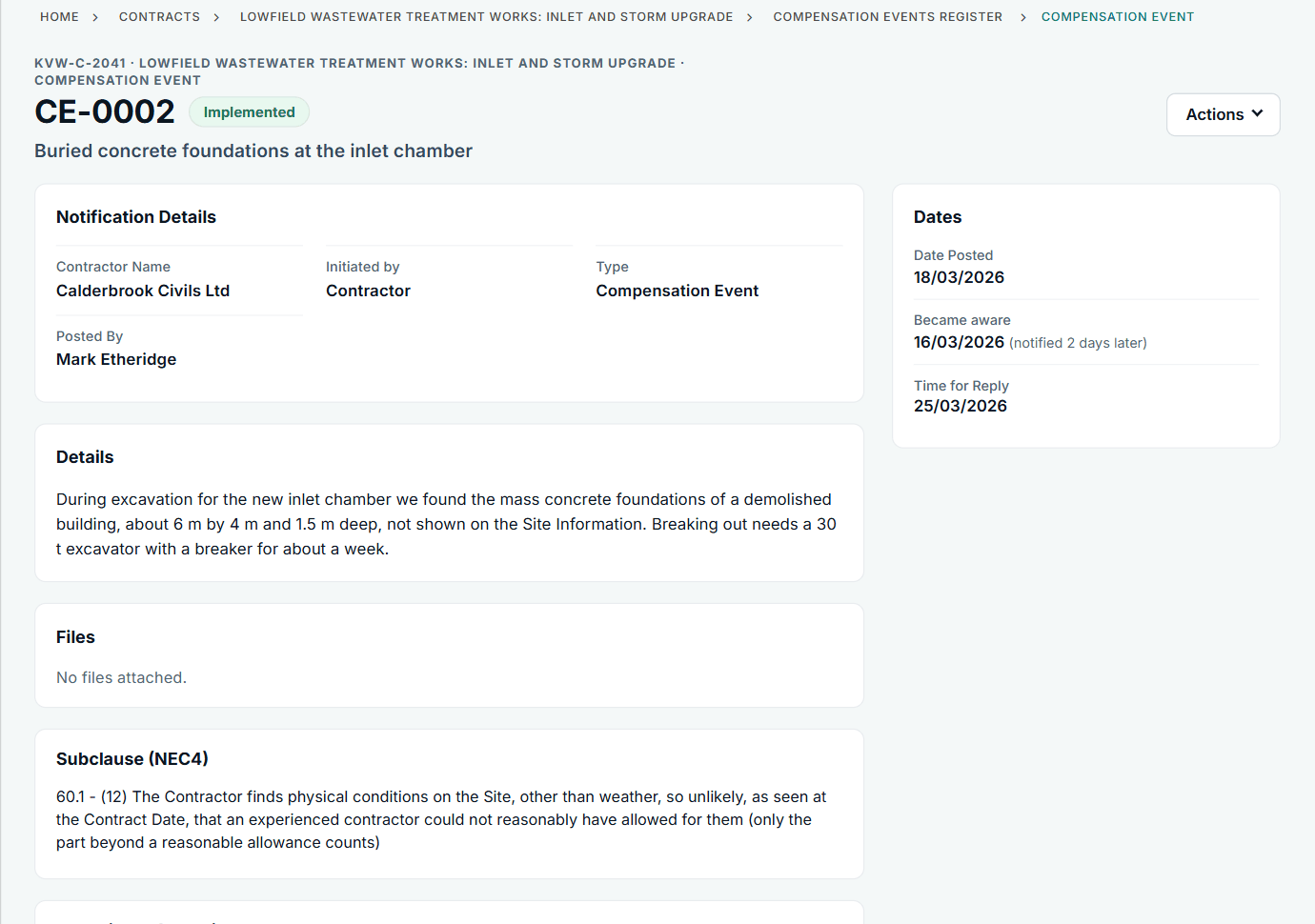
The record shows the date you became aware and how long you took to notify. See the worked example.
See how this works in practice
Click through Contract Status with sample contracts: raise the notice, reply to it, and watch both sides of one record.
Take the guided tour Book a demo
Use the NEC deadline calculator, use the free NEC tools or download free NEC templates.
This guide is general information in our own words, not legal advice. Your contract and its Contract Data always govern. NEC, NEC3 and NEC4 are trade marks of Thomas Telford Ltd; Contract Status is not affiliated with or endorsed by NEC.