
Generally, the Client has to pay the notified sum in full for that cycle, even if the certificate is wrong. A missed pay less notice loses the right to withhold for this payment, but it doesn't settle what is finally owed, so the difference can usually be dealt with afterwards.
What decides it is whether a valid notice was really out of time, and whether the sum is a true notified sum. The rule is at Y2.3 of Option Y(UK)2, in both NEC3 and NEC4, and reflects the Construction Act. Without that Option, the Act can still apply. For the wider question set, see NEC questions answered.
Is it actually too late? Count the dates
- Find the final date for payment. Y2.2 gives the due date, then the final date runs from it, unless the Contract Data states another period.
- Count back seven days. Under the NEC4 subcontract wording of Y2.1, day counts leave out Christmas Day, Good Friday and bank holidays. NEC3 follows the Act's own calculation. So check your wording around holidays.
- Check when and how the notice has to be received, following the pay less notice guide and clause 13.
A fictional NEC3 ECC example with no change to the standard period and no holidays in the way: assessment 1 June, payment due 8 June, last day for a notice 15 June, final date 22 June.
If you are the Client, or the Project Manager advising it
- Find out if the deduction is already in the certificate. Sums shown in the certified amount, such as properly assessed delay damages and retention, don't need a notice.
- Pay the notified sum by the final date, unless legal advice says otherwise. Late payment adds interest (51.2), and it opens the door to suspension and an adjudication you are unlikely to win on this point.
- Have the Project Manager correct the assessment in the next certificate under 50.6, if it was wrong. This is how the overpayment normally comes back.
- Give a notice for the next cycle, on time, if needed. A missed notice affects only the payment it relates to.
- Consider adjudicating the true value. It is available, but paying the notified sum first is the safer order. Take advice if you plan otherwise.
If the Contractor's solvency is the concern, or the sums are very large, take legal advice before the final date, because the general rule may have limits on particular facts.
If you are the Contractor
- Check that the sum you rely on is the certified one. Your application isn't the notified sum where a certificate has been issued.
- Write on the day after the final date, stating the sum, the date and that no valid notice has been received.
- Use your rights. Interest, suspension and adjudication are all open, and Y2.5 makes a proper suspension a compensation event (Y2.4 in NEC3).
- Expect a correction next month. Being paid an inflated sum now doesn't mean you keep it. If the amount was overstated, the next certificate can bring it down, and on a cumulative basis the Contractor could end up with a smaller or negative payment.
Worked comparison, with illustrative figures
| Event | Cycle 7 | Cycle 8 |
|---|---|---|
| Amount due as certified | £500,000 (overstated by £60,000) | £520,000 (true value) |
| Previously certified | £400,000 | £500,000 |
| Payment | £100,000: notice missed, so paid in full | £20,000: the correction is built in |
The Client is out of pocket by £60,000 for one month. Interest may also be payable on a correcting amount in some cases, under 51.3. The cost is mostly cash flow, unless the Contractor fails in the meantime.
What you will hear from the other side
| Argument | Response |
|---|---|
| Client: "The Project Manager told you about the problem in a meeting." | The clause needs a notice stating the sum considered due and its basis. A conversation doesn't do that |
| Client: "We emailed on the last day but one." | In time only if it reached the Contractor at least seven days before the final date. Otherwise, late. Count it precisely |
| Contractor: "You can't correct it at all now." | The notice rule is about this payment. 50.6 corrects assessments later, and an Adjudicator can decide the true value |
The contract also applies the rule both ways. If a certificate shows the Contractor owing money, the Contractor needs a notice to pay less. Authority matters too: a notice from a Project Manager with no written authority to act for the Client can be challenged. The Y(UK)2 guide covers the Option as a whole.
Related guides
- NEC Questions Answered: Real Situations on Site
- The PM Disallowed Our Costs: How Should We Respond?
- We Do Not Have Records for Our Defined Cost
- We Are Heading Over Target on Option C: What Now?
- The PM Certified Far Less Than We Applied For
- The Contractor Did Not Submit an Application: Do They Still Get Paid?
How this looks in Contract Status
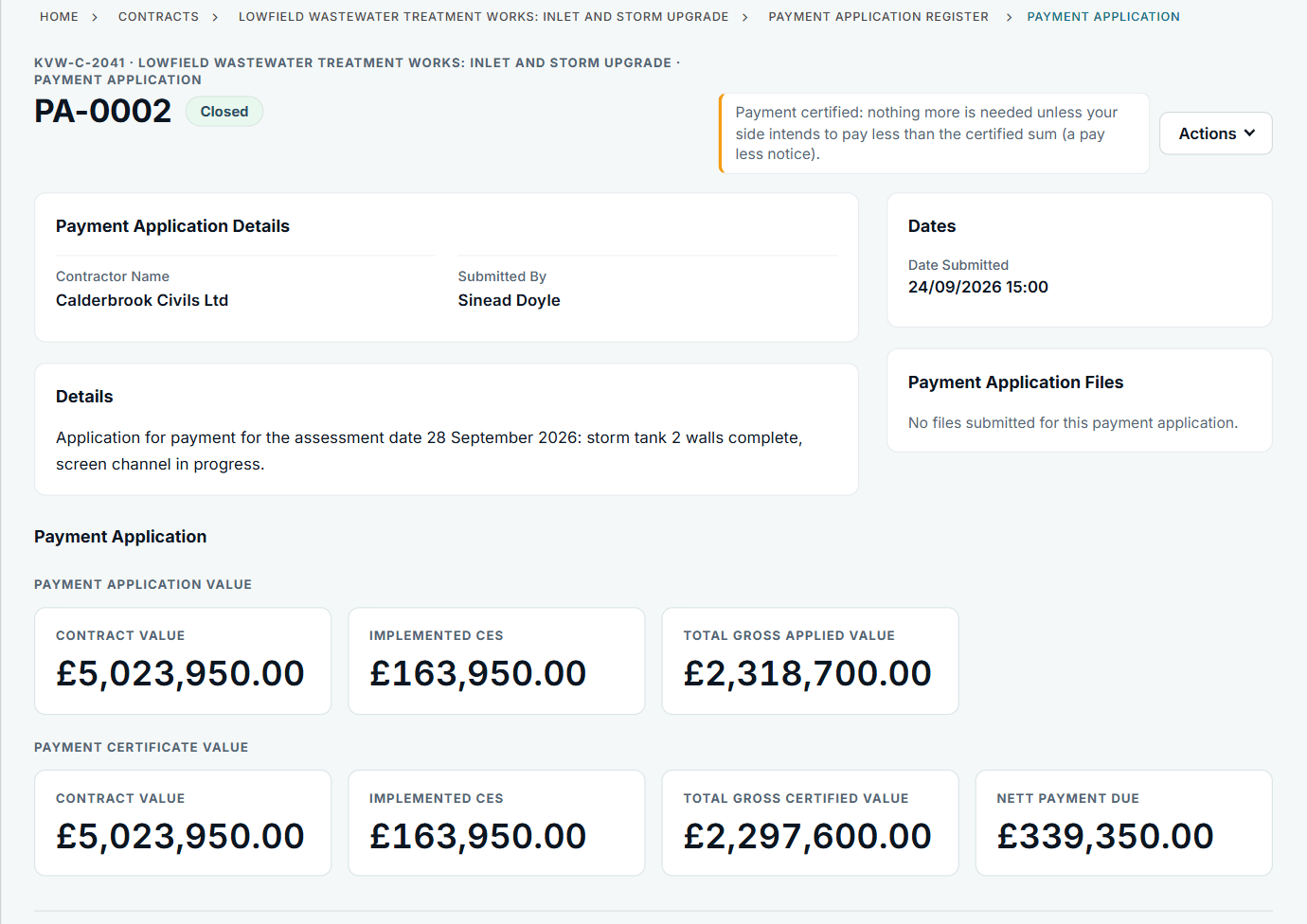
Applied and certified figures together on one record. See the worked example.
See how this works in practice
Click through Contract Status with sample contracts: raise the notice, reply to it, and watch both sides of one record.
Take the guided tour Book a demo
Use the NEC deadline calculator, use the free NEC tools or download free NEC templates.
This guide is general information in our own words, not legal advice. Your contract and its Contract Data always govern. NEC, NEC3 and NEC4 are trade marks of Thomas Telford Ltd; Contract Status is not affiliated with or endorsed by NEC.