
Not as a claim in its own right: a material price increase isn't a compensation event under NEC, and the core clauses give no general right to recover it. Whether any of it comes back depends on two things: whether Option X1 is in your contract, and which main Option you are on.
Who carries the increase
| Main Option | No X1 | With X1 |
|---|---|---|
| A, priced activity schedule | Contractor carries it all | An inflation amount is added to payments, by index |
| B, Bill of Quantities | Contractor carries it all | The same, by index |
| C, D, target cost | Higher Defined Cost is paid, but the target doesn't move, so the overrun passes through the share | The target moves by index, and the share reflects only the difference from the index |
| E, cost reimbursable | Client pays Defined Cost plus Fee. X1 isn't used | Not available |
| F, management | Depends on the subcontract route. X1 isn't used | Not available |
X1 can only be paired with Options A to D. It also works from indices, so it isn't a refund. A steel price spike that outruns the chosen index leaves you with the gap. The guide to Option X1 has the calculation.
Things that won't work
- Prevention, 60.1(19). A price rise doesn't stop you completing. It just costs more. See the prevention event for what the test looks for.
- Loading a quotation. A quotation for a real compensation event is built on forecast Defined Cost of that event. It can't be used to win back an unrelated rise elsewhere on the job.
What to do now
- Check the Contract Data for X1 and the Z clauses for anything on fluctuations. Check the base date and the proportions too.
- Quantify it properly. Get the current quotations, your tender allowance and the remaining quantities. Split out what's already bought.
- Fix prices on what you can. Early orders, longer agreements, and stock in hand may matter more than any contract argument.
- Give an early warning if it fits. On NEC4 ECC, 15.1 lets either side warn of something that could raise your total cost, even if it wouldn't change the Prices. It's voluntary, and it's a way of opening a discussion.
- Look for cost-saving options to propose. Clause 16 is the NEC4 route for a Scope change that reduces what the Client pays. On Options A and B, an accepted proposal reduces the Prices by only the value engineering percentage of the saving (63.12), and on C and D not at all (63.13), so a saving can help you both.
- Don't forget real events. Delay caused by a Client's late information may have pushed your purchasing into a higher market. The cost of the delay can be part of that event's effect, if you can show the link. The time bar is eight weeks (seven under NEC4 ECS).
Fictional example: same rise, three contracts
Illustrative figures. Steel is priced at £1,000 a tonne, and the Contractor buys 500 tonnes at £1,300, an overrun of £150,000. The steel index chosen has risen 20%, and steel is about 10% of the work for X1, on an illustrative £5 million job.
- Option A with no X1: the Contractor loses £150,000.
- Option A with X1: the steel line in the index gives a factor of 0.02. Over all the work that's up to £100,000 added, depending on timing and the other indices, which could all be moving up or down. The Contractor still bears a portion of the rise, as the steel used moved more than the index.
- Option C with a 50% share and no X1: if this is the only overrun within that band, the Contractor pays half: £75,000.
What the Client is likely to say
Expect "no" as a first answer: the Prices are fixed, you priced the risk and no event applies. That's correct on the contract. A public Client may also say that it can't pay for something the contract doesn't provide for, without a formal change. A private Client may be more open if you show the rise threatens the job, but will want something in return. If you do agree anything, clause 12.3 needs a change to be agreed, confirmed in writing and signed by both, so don't rely on a meeting note.
Practical steps for the next tender
Where volatile materials are a big share of the work, price the risk openly or ask for X1 at tender. If the Client has chosen fixed prices, show your assumptions and a validity date on your offer. Once the contract is signed, you can't choose X1 unless both Parties change it. See the guide to the Prices for how they are set, and what happens if you priced it wrong. For other questions, see NEC questions answered.
Related guides
- NEC Questions Answered: Real Situations on Site
- We Cannot Get Enough Labour: Is There Any Relief?
- An Event Beyond Anyone's Control Has Stopped Work
- The Client Wants Us to Finish Early: Must We Agree?
- A Utility Company Is Late: Who Takes the Risk?
- Our Materials Are Delayed by the Supplier: Who Takes the Risk?
How this looks in Contract Status
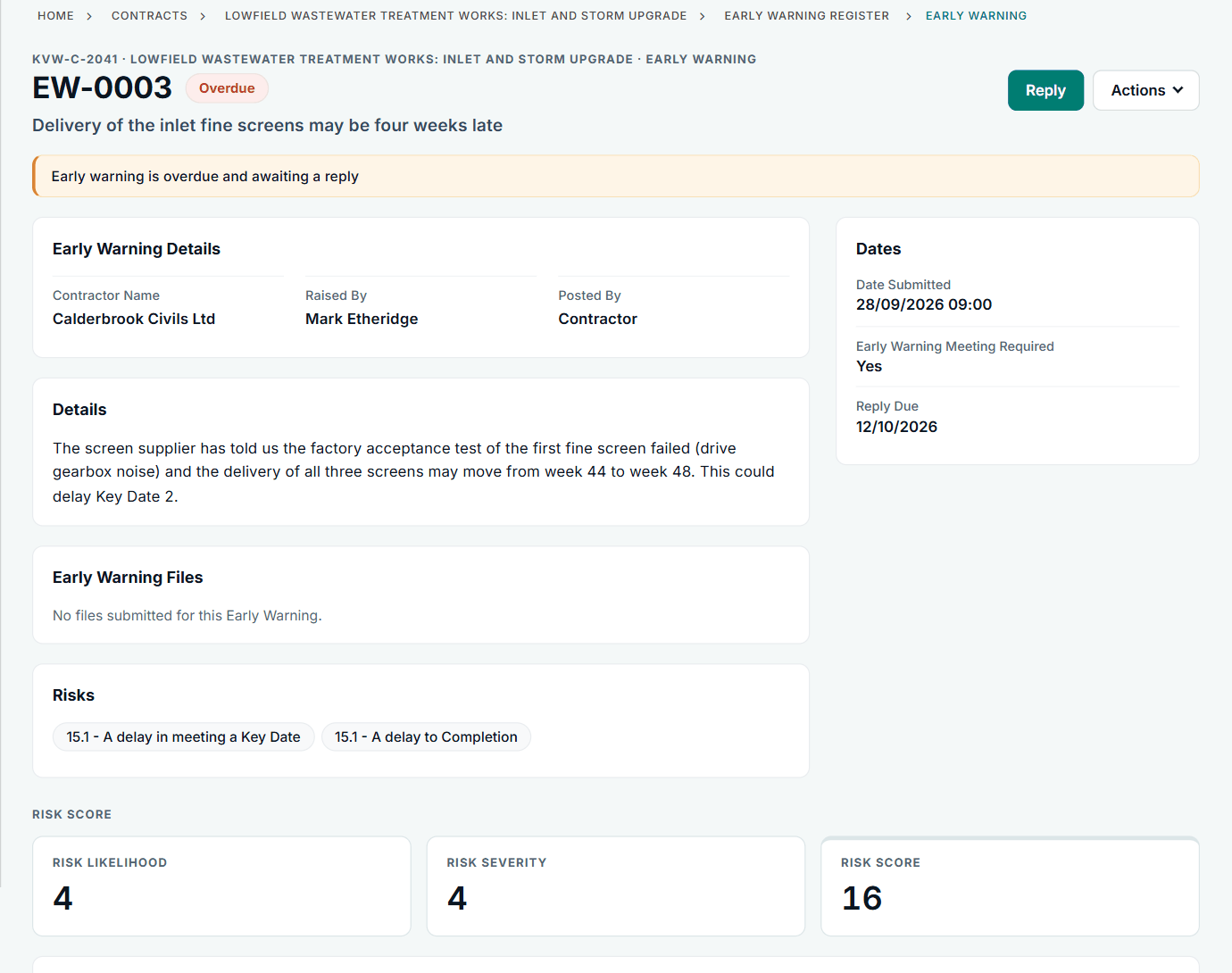
An early warning in Contract Status, with its risks, reply date and score. See the worked example.
See how this works in practice
Click through Contract Status with sample contracts: raise the notice, reply to it, and watch both sides of one record.
Take the guided tour Book a demo
Use the NEC deadline calculator, use the free NEC tools or download free NEC templates.
This guide is general information in our own words, not legal advice. Your contract and its Contract Data always govern. NEC, NEC3 and NEC4 are trade marks of Thomas Telford Ltd; Contract Status is not affiliated with or endorsed by NEC.