
It depends on your Contract Data: snow can be an NEC compensation event because the standard entries include days with snow lying at a stated time, but high wind counts only if someone added a wind measurement. Either way, the monthly result has to pass the one-in-ten-year test in 60.1(13).
That rule is the same in NEC3 and NEC4 ECC. A single storm or a blizzard that stops work for a morning doesn't qualify in itself; the test works on calendar months.
Snow and wind side by side
| Snow | High wind | |
|---|---|---|
| Listed in the standard form? | Yes, as days with snow lying at a time you state in the Contract Data | No |
| How it could qualify | The count for the month beats the one-in-ten value | A wind measurement was added to the Contract Data, with data to compare, and it passes |
| If it's not listed or fails | Contractor's risk under the priced Options; see below | Same |
| Related measurements | Days below 0°C may pass on their own in a long cold spell | None in the standard list. Rain may pass in the same storm |
Other things to read in the same part of the Contract Data are the place of measurement and the supplier. A coastal crane job and an inland weather station may give very different wind results, and the contract's chosen location still rules. The weather event guide sets the test out in full.
What to do now
- Read the Contract Data entry today, so you know which measurement could help, and at what time the snow reading is taken.
- Record the daily effect: which operations stopped, for how long and why. A crane out of service because it passed its wind limit, for example, should have its anemometer log saved.
- Warn early if Completion or a Key Date is at risk (15.1). A warning should look at the options for recovery as well.
- Check the month's figure when published. Compare it with the value for that calendar month. A proof file is explained in how to prove a weather event.
- Notify if it passes, within eight weeks of becoming aware (61.3), or seven under NEC4 ECS.
- If nothing passes, put the time into a revised programme instead (32.1), and tell your supply chain.
Worked example: the same week, two outcomes
A fictional steel-frame job, on Option A, with illustrative figures. In February, heavy snow lies for 6 days at the listed station against a one-in-ten value of 4, so 2 days are excess. The following week, gusts stop the tower crane for five days.
- Snow. The event is established, for the excess of 2 days. If those days hit critical work, planned Completion can move by the delay they caused. Add the running cost, at Defined Cost and Fee.
- Wind. The Contract Data has no wind entry, so the five lost crane days stay with the Contractor. Its anemometer log is useful for its own programme and for managing subcontractors, but gives no route to a compensation event.
Had the Client's tender team added "days with gusts over a stated speed" and supplied past data, the crane days could have been tested. Contractors with a tall or exposed job should ask for this before signing. Later on it is too late, as the entry is part of the contract.
What the other side will say
The Project Manager will probably point out that wind isn't on the list, and that the snow month only passed by a small margin. They may also say that with salt, heating or planned covers, work could have continued for some of those days. Clause 63.9 assumes you react competently, so keep notes on what you tried. Expect resistance if snow on the Site was deep but the listed station shows little. The station is what counts under the contract.
Is there any other route?
- Prevention, 60.1(19). Rarely. Weather has its own entry, and a claim for a near miss on the measure doesn't sit comfortably with the prevention test. A truly extreme event with some other effect, such as a landslip closing the only road off Site, is a different question. See the prevention event.
- Damage. A collapsed scaffold or a roof sheet torn off isn't about the test at all. It's a question of who is liable for the loss, and of insurance. See NEC insurance.
- Additional events. NEC4 allows extra compensation events in the Contract Data at 60.1(21). If your contract has one for wind or similar, use it.
In practice, the contract's narrow answer often feels harsh when a crane has stood idle for a week. Build crane downtime into your programme risk allowances, as the contract expects you to. Other readers' situations are in NEC questions answered.
Related guides
- NEC Questions Answered: Real Situations on Site
- The Site Flooded: Who Is Responsible Under NEC?
- We Have Not Been Given Access to the Site: What Do We Do?
- The Client Restricted Our Access Part Way Through
- It Has Rained for Weeks: Can We Claim for Weather?
- How Do We Prove a Weather Compensation Event?
How this looks in Contract Status
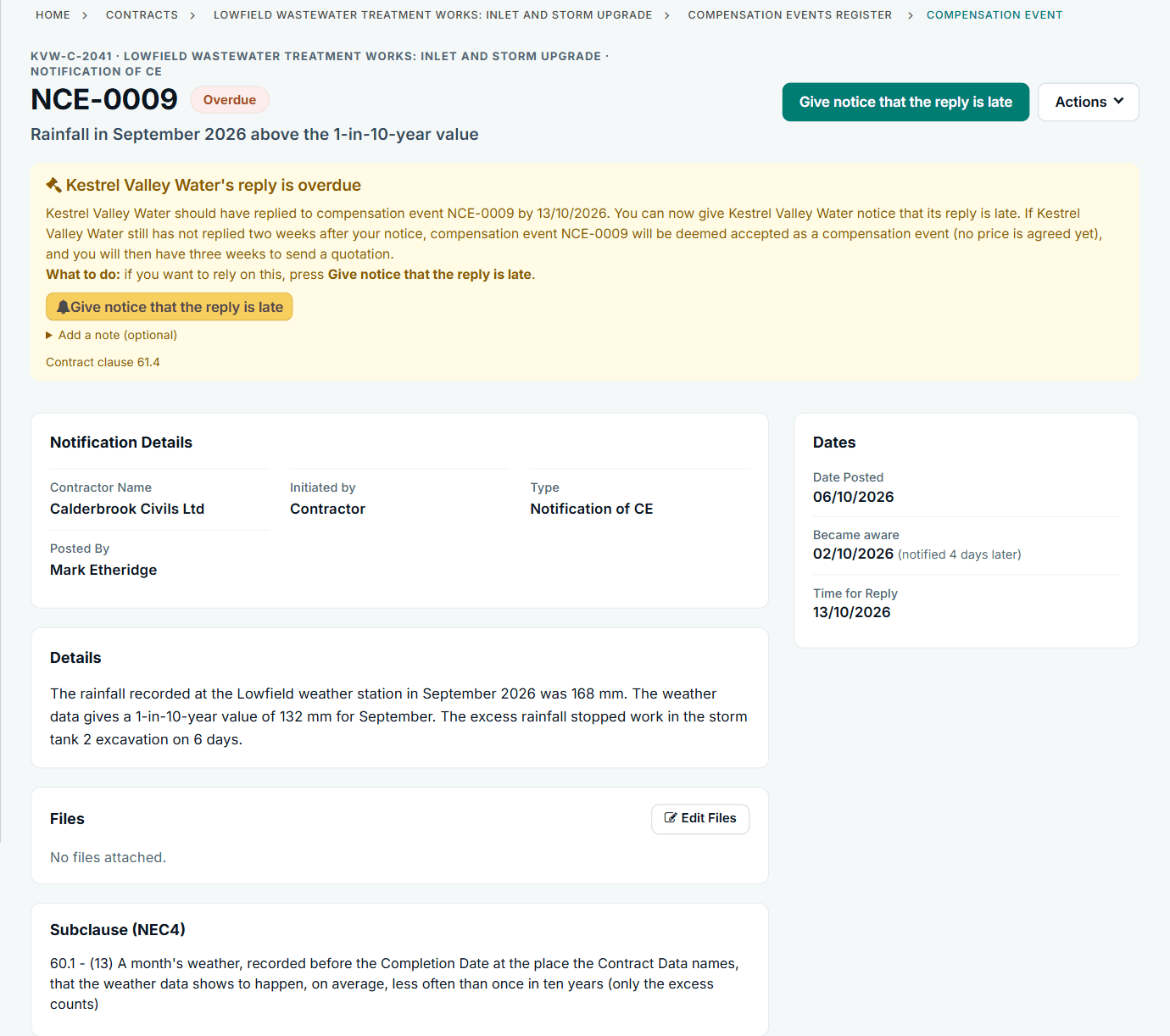
A weather event notified with the recorded figure against the one-in-ten value. See the worked example.
See how this works in practice
Click through Contract Status with sample contracts: raise the notice, reply to it, and watch both sides of one record.
Take the guided tour Book a demo
Use the NEC deadline calculator, use the free NEC tools or download free NEC templates.
This guide is general information in our own words, not legal advice. Your contract and its Contract Data always govern. NEC, NEC3 and NEC4 are trade marks of Thomas Telford Ltd; Contract Status is not affiliated with or endorsed by NEC.