
Quote it the same way as any other event, but split the work at the dividing date. For a compensation event after work done, the part finished by that date is priced at actual Defined Cost, the rest is priced as a forecast, and both attract the Fee under clause 63.1.
The dividing date decides everything. Work done after it counts as forecast, even if it's finished before you quote. So the answer depends on what caused the event and when it was notified. The rule is at 63.1 in NEC3 and NEC4 ECC. See other cost questions in our NEC questions section.
Find your dividing date
| Event came from | Dividing date | Example |
|---|---|---|
| An instruction, notification, certificate or changed decision (NEC3 lists a corrected assumption, not a notification) | Date of that communication | Instruction of 3 May to add a stair |
| Anything else | Date the event was notified | Unforeseen slab found 10 May; notified 17 May |
Notice what this does. If you notified on 17 May and did the work up to 14 June, the work from 18 May onward is priced as a forecast from the position on 17 May. You may know exactly what it cost, and the Project Manager will too. In practice, that real knowledge may inform everyone's view of what a reasonable forecast would have been, but the contract doesn't turn it into actual cost.
What to do now
- Confirm the event is notified. If it isn't, do that today: late-found events can still fall to the eight-week bar.
- Check the time for quoting. It's three weeks from the instruction under 62.3 (two in the NEC4 subcontract).
- Collect the records for work before the dividing date. See the list below.
- Build a forecast for work after it. Base it on what was reasonably expected at that date.
- Work out delay on the right programme. Under NEC4 63.5, compare against the Accepted Programme in force on the dividing date.
- Remove what wasn't caused by the event. The assessment is the event's effect, not everything that happened in those weeks.
The records you need for the actual part
- Allocation sheets showing who worked on the event, with dates and hours
- Equipment records: what was on site, on hire or standing, and the hire rates or contract rates
- Delivery tickets and invoices for materials, with discounts recoverable taken off
- Subcontract accounts, and what's due to each subcontractor
- Photographs and diary entries showing the event's effect on the work
Defined Cost means only what's in the applicable schedule of cost components, so a marked-up invoice from your own group company, or a rate from your tender, may not match. Our guide to working without records covers what to do if there are gaps.
Worked example
A fictional Option A job, with illustrative figures. The Contractor hits an unforeseen concrete slab on 10 May, and notifies on 17 May. Breaking it out finishes on 7 June. The Project Manager instructs quotations on 20 May.
| Period | Basis | Amount |
|---|---|---|
| 10 to 17 May | Actual: breaker, operators, muck away, from the records | £7,800 |
| 18 May to 7 June | Forecast at 17 May: three weeks' planned breaking | £21,000 |
| Fee at an illustrative 10% | On the two amounts above | £2,880 |
| Quotation | £31,680 |
If real cost for the second period turned out to be £26,000, the Contractor should expect the forecast to be tested: what could it reasonably have predicted on 17 May? If the crew had in fact already found harder concrete before notification, that counts.
What the Project Manager may raise
- "Just give us actuals for all of it." It's often practical, and the two sides can agree a figure on rates or lump sums (63.2). But know what the contract says if there's no agreement.
- "You didn't warn." A statement under 61.5 reduces the assessment to what a warned event would have cost. Work done already makes that easier to argue.
- "You could have done that for less." The assessment assumes a competent, prompt response and reasonably incurred cost (63.9). Be ready to explain what you chose and why.
What doesn't matter
Whether the work was on your tender rates doesn't decide the assessment, unless the rates are agreed. That the work is finished doesn't make a late quotation acceptable. And the fact that you've already spent the money doesn't reverse the 66.3 rule: once implemented, it stands, so include everything now. See how assessment works for the wider rules.
Related guides
- NEC Questions Answered: Real Situations on Site
- Actual Cost Came In Higher Than Our Accepted Quotation
- Actual Cost Was Less Than the Accepted Quotation: Do We Keep It?
- The Contractor Has Not Submitted a Quotation: What Can the PM Do?
- The PM's Assessment of Our Compensation Event Is Too Low
- We Cannot Price the Quotation Yet Because Facts Are Unknown
How this looks in Contract Status
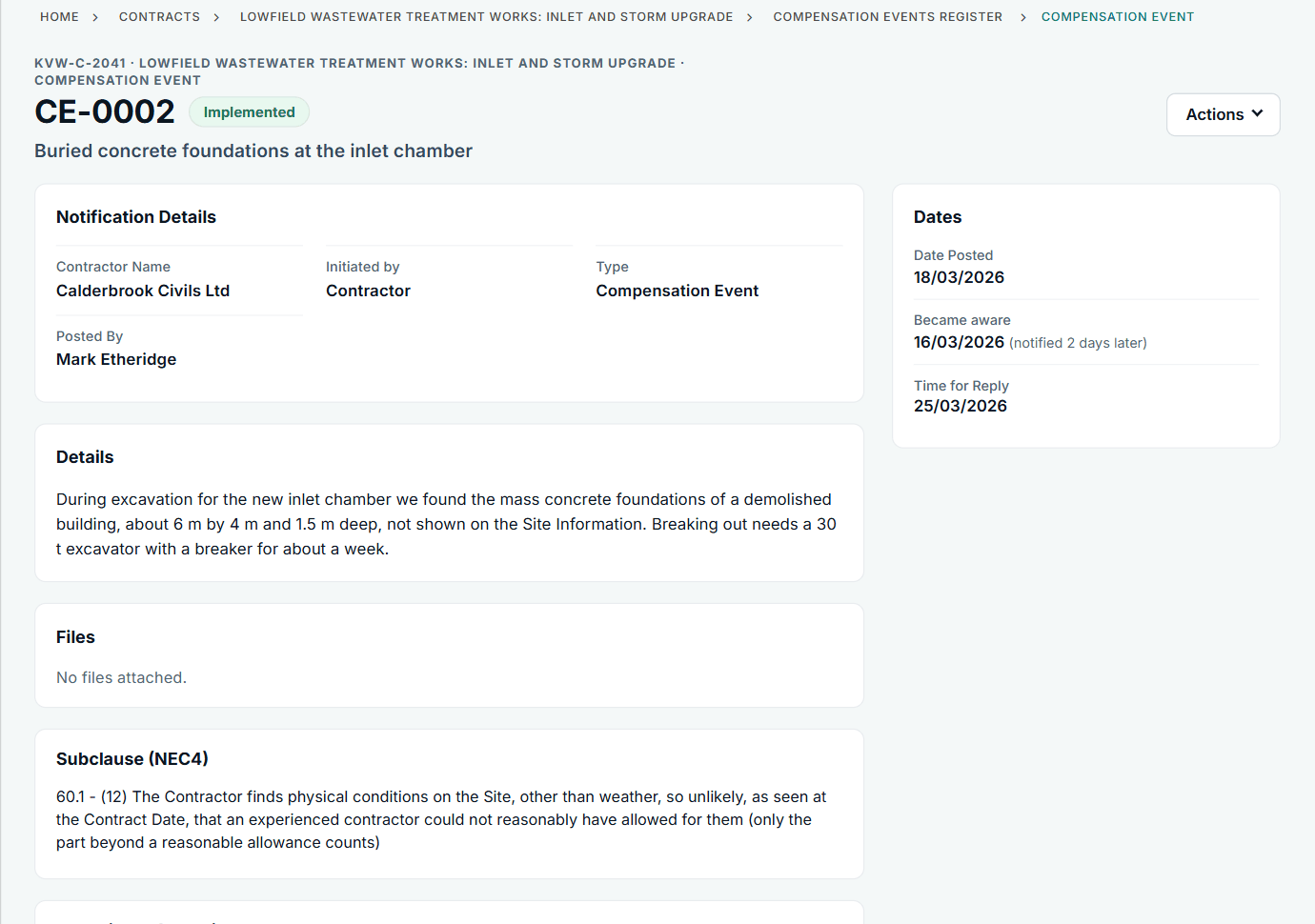
The record shows the date you became aware and how long you took to notify. See the worked example.
See how this works in practice
Click through Contract Status with sample contracts: raise the notice, reply to it, and watch both sides of one record.
Take the guided tour Book a demo
Use the NEC deadline calculator, use the free NEC tools or download free NEC templates.
This guide is general information in our own words, not legal advice. Your contract and its Contract Data always govern. NEC, NEC3 and NEC4 are trade marks of Thomas Telford Ltd; Contract Status is not affiliated with or endorsed by NEC.