
You do, in most cases. A contractor design delay under NEC is your risk: if the Scope says you design it, a designer you appointed is treated as if you were doing the work yourself, so its lateness gives you no compensation event, no extra time and no change to the Prices.
What decides it is the Scope (design allocation under clause 21.1) and the real cause of the lateness. Clause 26.1 keeps you responsible for subcontracted work, and a design consultant sits on your side of the line. The money then depends on your main Option, as covered below. For other design and drawing situations, see NEC questions answered.
What to do this week
- Give an early warning anyway. Clause 15.1 (16.1 in NEC3) applies to anything that could delay Completion or a Key Date, not only other people's failures. The Project Manager may be able to help, for example by allowing a different order of work or by bringing forward Client decisions. See warning about late drawings.
- Ask the designer why. Get the answer in writing. If it says it was waiting for Client information, get the dates, because the answer changes.
- If Client information is a cause, notify that part. The eight weeks in clause 61.3 is running on it. It's a different event from your designer's own lateness, and it should be argued separately.
- Show the plan in your next programme. A revised programme has to show how you'll deal with delays (32.1). Don't leave the delay out in the hope of catching up.
- Write to your designer under its appointment. Your recovery, if any, is under that contract, not the NEC one. Check what it says on programme, liability caps and notice.
Who bears the cost, by Option
| Option | Extra cost of the delay | Delay to Completion |
|---|---|---|
| A and B | Contractor. The Prices don't move | Contractor, including any delay damages under Option X7 |
| C and D | Paid as Defined Cost unless disallowed, but the target doesn't rise, so it feeds into the Contractor's share | Contractor |
| E | Paid as Defined Cost plus Fee unless disallowed | Contractor. The Completion Date doesn't move |
On Options C, D and E, check the Disallowed Cost list. An obvious trap is any amount paid to the designer that its own contract didn't require you to pay.
Where the answer changes
| The designer was late because | Likely position |
|---|---|
| It was under-resourced or started late | Your risk |
| Your own team was late with coordination or surveys | Your risk |
| The Client didn't provide information by the date on the Accepted Programme | Possibly 60.1(3), for that effect only |
| Others, such as a utility or the Client's separate designer, didn't keep to the times on the Accepted Programme | Possibly 60.1(5) |
| The Project Manager instructed a change to Client-provided Scope, forcing a redesign | 60.1(1), arising from the instruction |
| The Project Manager changed your design at your own request | Not an event: 60.1(1) carves this out |
| A design submission wasn't answered within the period for reply | Possibly 60.1(6) |
| Your design was rejected for a reason the contract allows | Your risk: withholding acceptance for a stated reason isn't an event (13.8) |
The conversation with the Project Manager
Expect to be asked for a recovery plan. Expect, too, a firm line if you try to present your own delay as a Client problem: the first thing the Project Manager will do is read the Scope's design split. If you're notifying for a Client-side cause, be precise: "Package 4 structural design was late for two reasons. We're notifying only the ten days caused by the survey data that arrived after the date on the Accepted Programme."
The contract says a mixed delay is assessed on the effect of the compensation event, and the assessment assumes you reacted competently. In practice, you'll need a dated trail from the designer that separates the causes. Build it at the time; it's hard to reconstruct.
A warning also has a commercial value. A Client told early of a design slip, along with a plan, can often move its own activities. A Client that finds out from the drawing register usually can't. More on the design role is in the Contractor's responsibilities.
Related guides
- NEC Questions Answered: Real Situations on Site
- Revised Drawings Arrive After IFC: Is That a Change to the Scope?
- Our RFI Has Not Been Answered: What Can We Do?
- The Project Manager Replied Late: Is It Automatically a Compensation Event?
- IFC Drawings Are Late: Should We Give an Early Warning?
- Are Late IFC Drawings a Compensation Event?
How this looks in Contract Status
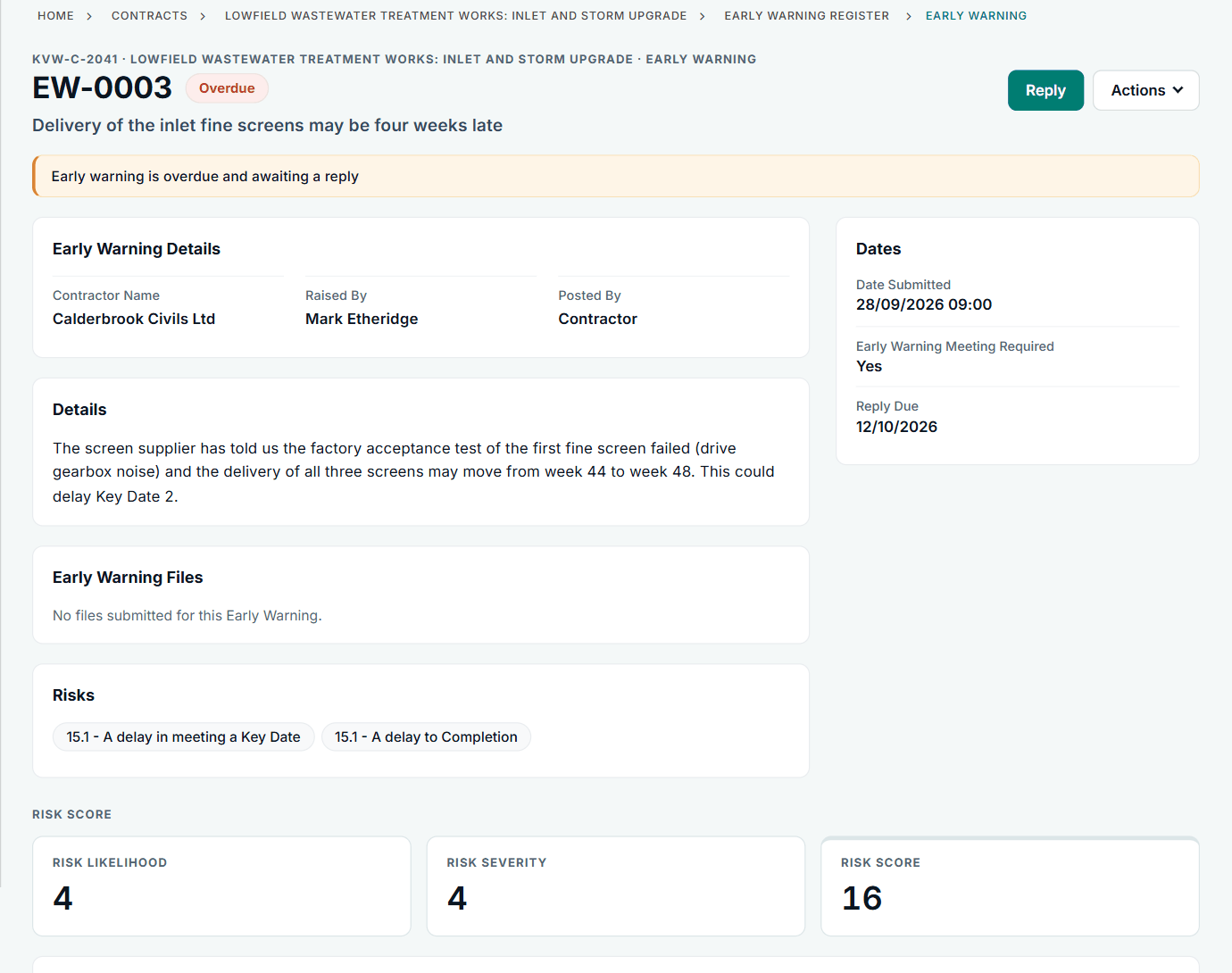
An early warning in Contract Status, with its risks, reply date and score. See the worked example.
See how this works in practice
Click through Contract Status with sample contracts: raise the notice, reply to it, and watch both sides of one record.
Take the guided tour Book a demo
Use the NEC deadline calculator, use the free NEC tools or download free NEC templates.
This guide is general information in our own words, not legal advice. Your contract and its Contract Data always govern. NEC, NEC3 and NEC4 are trade marks of Thomas Telford Ltd; Contract Status is not affiliated with or endorsed by NEC.