
Check whether the reason is one the contract allows: a PM not accepting a programme under NEC needs to give a reason under 31.3, and only four count. If it's a valid reason, fix the programme and resubmit quickly; if it isn't, withholding acceptance is itself a compensation event under 60.1(9).
What's at stake is your position on compensation events, because without an accepted, current programme the Project Manager can assess them against its own view of the remaining work (64.2).
What to do, with the deadlines
- Check the dates. The Project Manager has two weeks from your submission to accept or give reasons (31.3).
- If there's no reply in two weeks, on NEC4 ECC: notify the failure. If it continues for one further week, the programme is treated as accepted. See deemed acceptance of a programme. Under NEC4 ECS, the periods are three weeks and two further weeks.
- If there's no reply on NEC3 ECC: there's no deemed acceptance. A late reply can be a compensation event under 60.1(6), but the programme still isn't accepted.
- If there are reasons, test them against the table below on the day they arrive.
- Resubmit, with the point corrected, as soon as you can. The last Accepted Programme stays in force until then.
- Keep notifying events and quoting. Don't let the dispute delay them. The eight-week bar under 61.3 keeps running (seven weeks under NEC4 ECS).
Is the reason valid?
| Reason given | Allowed by 31.3? | What it's about |
|---|---|---|
| The plans it shows are impractical | Yes | For example, a crane doing two jobs at once, or logic that doesn't work |
| It leaves out information the contract requires | Yes | Missing float, time risk allowances, resources or statements required by 31.2 |
| It doesn't represent your plans realistically | Yes | Output rates or dates that the Project Manager can show you don't really intend to achieve |
| It doesn't comply with the Scope | Yes | Working hours, phasing or constraints in the Scope |
| "We don't agree with the compensation event dates shown" | Only if it fits one of the four | For example, if the dates shown make the plan unrealistic |
| "It shows the job finishing later than we want" | Not by itself | The programme is your forecast. A later planned Completion isn't a stated reason, as long as it's realistic |
| "We're still reviewing it" after two weeks | Not a reason | Treat as no reply |
A reason that's not on this list engages 60.1(9), and 13.8 confirms that withholding for a stated reason isn't an event. Treat the eight-week time bar as running from the date of that reply.
Sample reply to a reason that doesn't fit
"Your reply of [date] does not accept our programme revision [n], because [quote reason]. That reason is not one stated in clause 31.3. We ask you to accept the programme, or to state a reason the contract allows, by [date]. We notify a compensation event under clause 60.1(9) for the effect on our work of the withheld acceptance."
Fictional example
A sewer upgrade on Option C. Revision 4 shows planned Completion two weeks past the Completion Date, with four events still unresolved and shown as "proposed". The Project Manager replies that the programme is unrealistic because the output on pipe-laying is 15 metres a day, while the last three months averaged 9. That's a valid reason, supported by data. The Contractor changes the rate to 11, adds a second gang from month 8, and resubmits. It's accepted a week later.
If instead the reply had been only "planned Completion is after the Completion Date, so it's not acceptable", the Contractor could have answered that the programme states its real plan. Delay damages are the Client's remedy for that, not a refusal of the programme.
What's the consequence if it stays unaccepted?
- The last Accepted Programme stays the baseline for checking access and Others' dates under 60.1(2), (3) and (5).
- Compensation events: if your latest programme hasn't been accepted for a reason the contract gives, the Project Manager can assess the event (64.1), and use its own programme for the remaining work (64.2).
- Payment: the one-quarter retention at 50.5 (NEC3 ECC: 50.3) is about having submitted a first programme with the required information, where the Contract Data names none. An unaccepted later revision doesn't trigger it. See when there's no Accepted Programme for the wider effects.
Likely attitudes on both sides
A Project Manager may worry that accepting a late programme looks like agreeing to the delay. The contract says acceptance doesn't change the Contractor's responsibility, and the Completion Date doesn't move because a programme is accepted. Saying this openly can unlock things. In practice, a short review meeting with the planner present can cut repeat rejections. For the mechanics, see the guide to clause 31.3, and for more, NEC questions answered.
Related guides
- NEC Questions Answered: Real Situations on Site
- There Is No Accepted Programme: How Are Events Assessed?
- The Contractor Has Stopped Updating the Programme
- The Contractor Has Not Submitted a First Programme
- The Client Wants Us to Finish Early: Must We Agree?
- We Are Running Behind Programme: What Should We Tell the PM?
How this looks in Contract Status
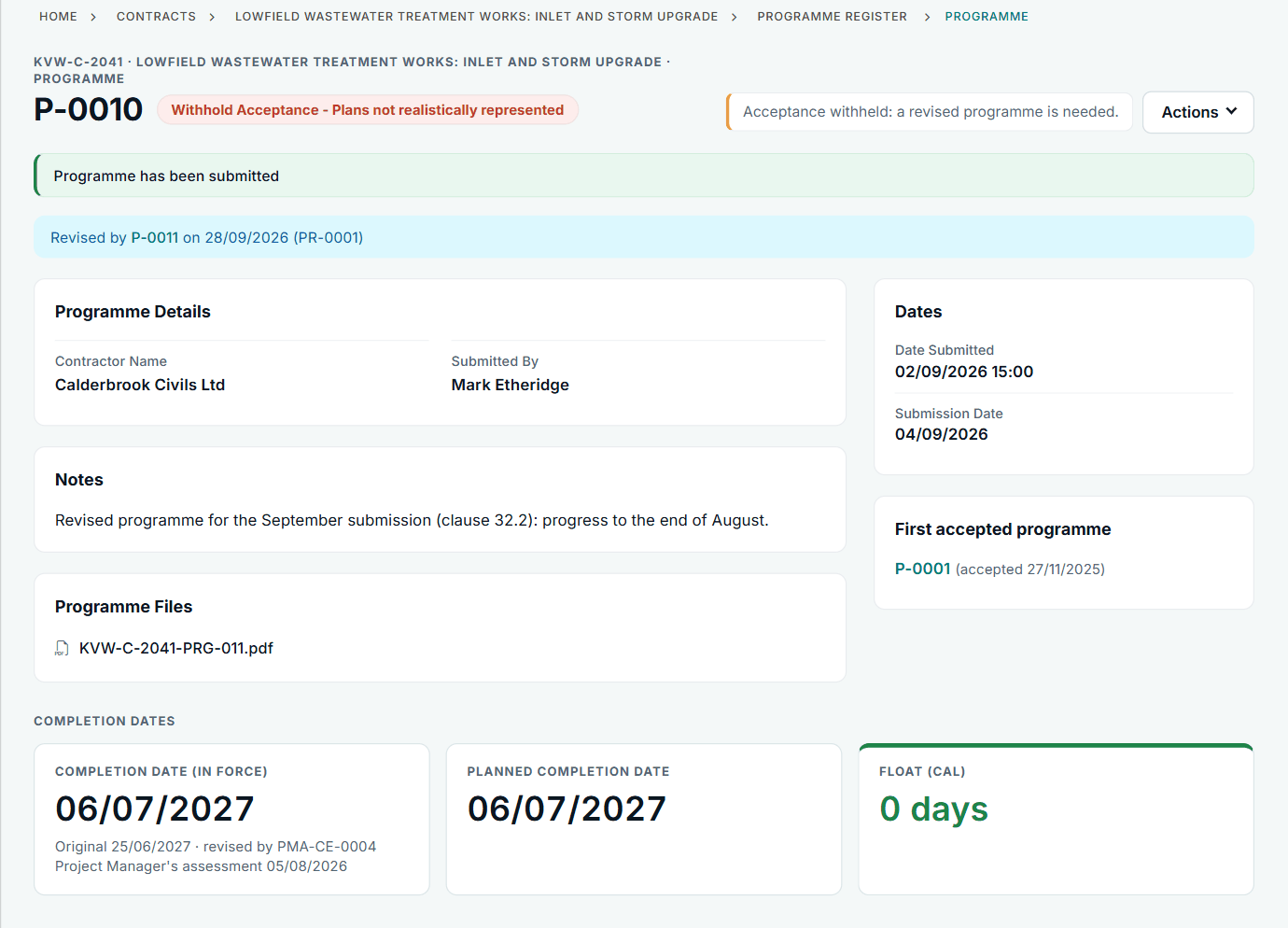
A programme not accepted, from the Contractor side, with the reason in its status. See the worked example.
See how this works in practice
Click through Contract Status with sample contracts: raise the notice, reply to it, and watch both sides of one record.
Take the guided tour Book a demo
Use the NEC deadline calculator, use the free NEC tools or download free NEC templates.
This guide is general information in our own words, not legal advice. Your contract and its Contract Data always govern. NEC, NEC3 and NEC4 are trade marks of Thomas Telford Ltd; Contract Status is not affiliated with or endorsed by NEC.