
Tell them early and plainly: a contractor behind programme under NEC should give an early warning as soon as Completion or a Key Date is at risk, then show the delay and your plan on a revised programme. What decides how much further you go is why you're behind, because your own delay, compensation events and a mixture of the two lead to different letters.
The Project Manager can't instruct you to accelerate, but saying nothing doesn't help you. It makes any later compensation event weaker, and your Accepted Programme becomes a poorer baseline.
What to do now
- Find out how late you really are. Update the programme with actual progress, and see what's happened to planned Completion and any Key Dates.
- Give an early warning under 15.1 (NEC3 ECC: 16.1) if Completion or a Key Date could be delayed. That's a contract duty, not a courtesy, and it applies as soon as you become aware.
- Check the reasons, and the eight-week clock. For anything caused by a listed event, notify under 61.3 now (seven weeks under NEC4 ECS). Old items may already be out of time, unless they arise from a Project Manager's instruction or similar.
- Submit a revised programme. Clause 32.1 requires it to show actual progress, the effect on remaining work, and how you plan to deal with delays. Clause 32.2 sets the timing: when instructed, at your own choice, and at the Contract Data interval at the least.
- Work out your exposure: delay damages under X7 if the Completion Date is at risk, and cost under 25.3 for a missed Key Date.
- Decide on recovery, and show what's real rather than what looks good.
Which message fits?
| Why you're behind | What to say | What it affects |
|---|---|---|
| Your own or your supply chain's performance | Warn, show the recovery plan. No claim | Your float goes first, then delay damages |
| A listed event, such as late access | Notify a compensation event, and quote | The Completion Date moves if planned Completion is delayed |
| Both at once | Warn, and notify the event separately. Show them apart on the programme | Expect arguments on what caused what |
| Not sure yet | Warn now, and don't commit to a cause | Keeps your position open |
Sample wording
"We give an early warning under clause 15.1. Current progress on [package] is [X] behind the Accepted Programme, and we forecast planned Completion moving from [date] to [date]. This may affect the Completion Date and Key Date [n]. Causes are being reviewed; any compensation events will be notified separately. A revised programme showing our recovery plan will follow by [date]. We propose an early warning meeting this week."
Warning like this doesn't accept fault. If that's your concern, read about whether a warning admits liability.
Why honest programmes help you
A fictional example, with illustrative dates. The Completion Date is 28 November, and the Accepted Programme shows planned Completion on 7 November, so three weeks of terminal float. The Contractor falls four weeks behind on its own account but doesn't update the programme. Then late access costs two more weeks.
- The Project Manager asks for a revised programme. It shows planned Completion on 5 December.
- The access event is assessed under 63.5 on planned Completion against the Accepted Programme at the dividing date. If that programme is months old, its starting point doesn't reflect progress. Expect an argument about how the Contractor's slippage since then is treated in the assessment.
- If the programme hadn't been updated, the assessment gets more difficult, and the Project Manager may use 64.1 and 64.2 to assess the event on a programme of its own. See programmes and compensation events.
A current programme gives you the cleanest route to an extended date, even if it shows bad news.
What the Project Manager can and can't do
| Can | Can't |
|---|---|
| Instruct a revised programme within the period for reply (32.2) | Instruct you to finish earlier than the plan or add shifts, as a contract requirement |
| Decline to accept a programme that doesn't represent your plans realistically (31.3) | Demand a programme showing a date you can't reach. Acceleration needs clause 36 |
The likely response
Expect pressure, questions about resources and requests for a recovery plan. They may also say your own delay is the real cause of anything you notify. The contract says you carry your own delay and warn about it. In practice, showing up with a plan buys more goodwill than waiting until the Completion Date is close. If you're adding resources at your own cost, say so and keep the records, as those may help in any dispute about causes. On a target contract, check what's allowable. See also labour shortages and the rest of NEC questions answered.
Related guides
- NEC Questions Answered: Real Situations on Site
- The PM Will Not Accept Our Programme: What Now?
- There Is No Accepted Programme: How Are Events Assessed?
- The Contractor Has Stopped Updating the Programme
- An Event Beyond Anyone's Control Has Stopped Work
- The Client Wants Us to Finish Early: Must We Agree?
How this looks in Contract Status
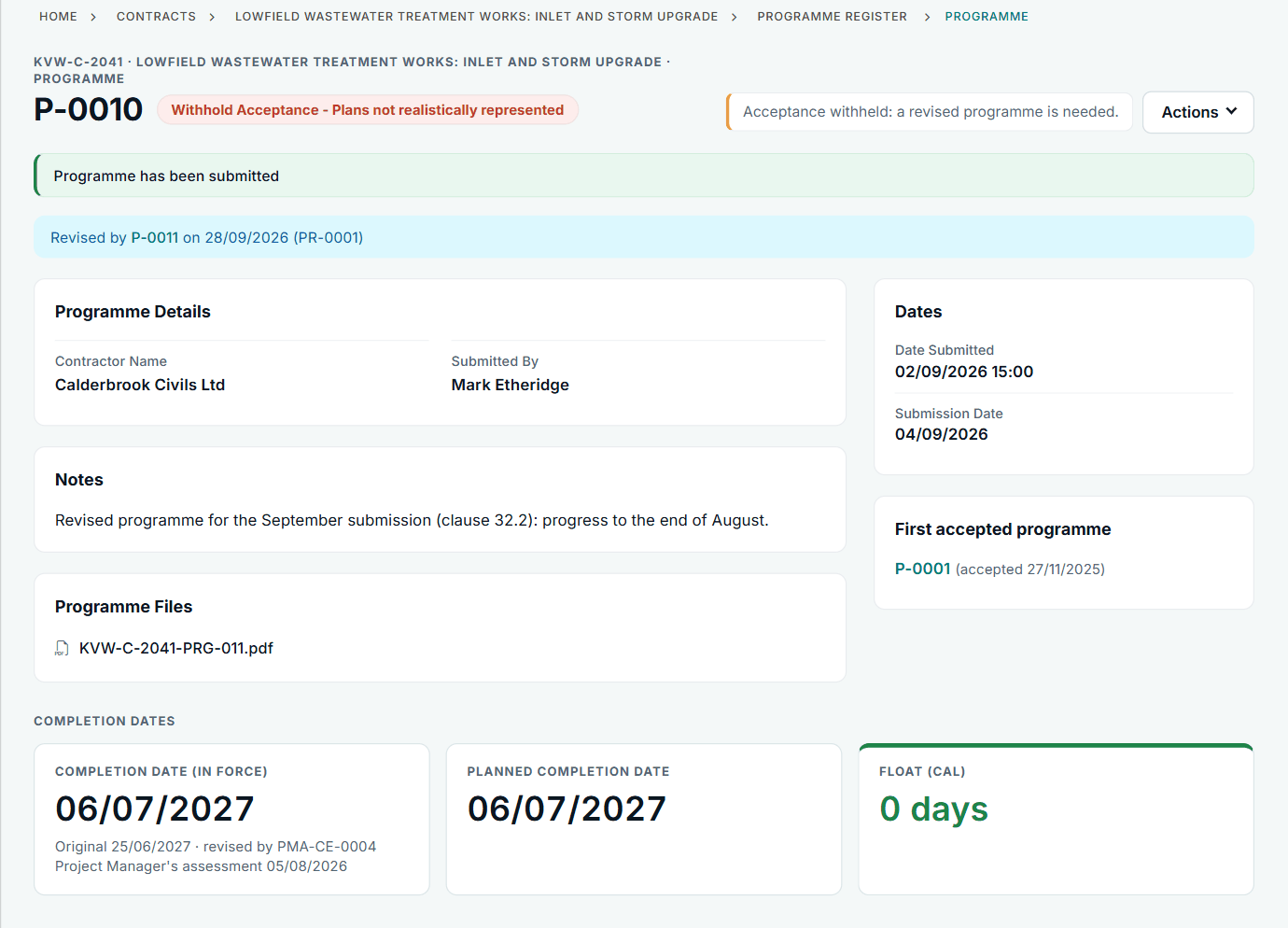
A programme not accepted, from the Contractor side, with the reason in its status. See the worked example.
See how this works in practice
Click through Contract Status with sample contracts: raise the notice, reply to it, and watch both sides of one record.
Take the guided tour Book a demo
Use the NEC deadline calculator, use the free NEC tools or download free NEC templates.
This guide is general information in our own words, not legal advice. Your contract and its Contract Data always govern. NEC, NEC3 and NEC4 are trade marks of Thomas Telford Ltd; Contract Status is not affiliated with or endorsed by NEC.